Sunday, April 28, 2013

Old Climbers, Talking


i.
At the gym I see another old climber on the stationary bike, sit next to him and begin pedaling. What have you been doing? I ask.
Eating, he says.  He’s pedaling hard.
I haven’t seen him since early winter when we spent a day skiing over Hatcher Pass on about three inches of snow.  We had a slow start to the winter that’s just now winding down in late April. We begin talking about the recent American Alpine Club meeting, which celebrated the 50th anniversary of the first American ascents of Everest.  These guys are mostly in their 80s now. The leader, Norman Dyhrenfurth, is 94.  This reminds Old Climber Number 1 to make a little speech about the pussification of American climbing. 
So, he says, these AAC climbing grants.  What a joke.
Do tell.
They gave one to these guys to do a route on Deborah (a remote peak in the AK Range) and they didn’t get anywhere near the climb.  I’m not sure they left the spot where the plane dropped them off.  You know why?
I shake my head.
Guess, he says, just guess.
Don’t tell me, I say, too cold?
TOO COLD!!  He laughs maniacally and I join him.  Of course, it’s too cold.  It’s always too cold up here.  Ridiculous, he says.  Too cold, shaking his head
OC1 has climbed Denali in winter.  A life-long Alaskan, as teenagers he and his pals routinely camped in winter conditions that would be major expeditions for outsiders.
I remind him that the AAC isn’t just for elite climbers anymore.  He had forgotten about that.  Okay, he says, I guess we should just hand out money randomly for average folks’ bouldering tick lists.
Pedaling, pedaling.

ii.
OC1 says he was invited to the Ruth (a glacier in the AK Range, where all the climbing is hard and dangerous) What am I going to do there?  Sit in a tent and drink?
There’s nothing to do.  It’s either the south face of Dickey (a 5,000 foot rock climb in arctic conditions) or nothing.  Indeed, my only trip to the Ruth the snow conditions were so sugary that we ended up just skiing around.  Great trip, actually.
Anyway I’ve already spent two months up there, he adds.
I’m not sure what he’s driving at.   I think he’s finding compromise . . . difficult.
Pedaling, pedaling.

iii.
He tells me about the backcountry skiing he’s gotten in this season—a considerable amount.  I tell him that most of my time was spent on the Nordic trails.  I don’t mention my disastrous season racing slalom in the Town League down at Alyeska.  Then I remember that I skied Arctic to Indian, a long 23 mile point-to-point day.  That’s something, he said. Something, in OC1’s book, is actually . . . something.
Yeah, I said, but it kicked my ass.
It’s supposed to, he said.
Pedaling.
I tell him that most of the time I’m on the wrong skis.  Plus, I never have the right stuff in my pack.  I should have had a stove, an extra pair of socks and a huge pair of mittens.
You didn’t need that stuff.
I should have had it.
But you didn’t need it, did you?
I might have needed it.
Pffft.
Pedaling, pedaling.

iv.
We talk about other climbers, our age, their lecturing about climbing to some star-struck young  climbers.  Same old stories, nothing new.  It’s embarrassing, he says.
They were telling those stories twenty years ago.
What are we supposed to do? I said.  I am thinking about privation, exhaustion, frozen digits: not all that appealing to me, now.
He shrugs.
I know what he means—our best days in the mountains are undoubtedly behind us, and it’s hard to reconcile oneself to that.  Further, who wants to hear it?  Ancient history.  Move along people, nothing to see here.
Pedaling, pedaling.

Coda
We agree to do some long road rides when it warms up.


Saturday, April 20, 2013

Herzog(s): an Appreciation

-->
Last week I saw the Werner Herzog film Happy People: a Year in the Taiga.  The taiga is in Russia but is much like the villages of Alaska, unreachable by road.  I will see anything with Herzog’s name on it, any time.
The taiga is the blank map Herzog was thinking of, I think, when he said, “Adventure is over. All the white spots on the map have been discovered.”
“Herzog never created a single film that is compromised, shameful, made for pragmatic reasons, or uninteresting.  Even his failures are spectacular.” So said Roger Ebert, getting it exactly right.  The condition to which every artist should aspire.
I own two films by Herzog, Every Man for Himself and God Against All (later titled The Mystery of Kasper Hauser–its subject), and The Cave of Forgotten Dreams, about the cave paintings of Chauvet. I also own three books by him: Pilgrims: Becoming the Path Itself, Conquest of the Useless, and Of Walking in Ice.  Somewhat odd, in that his films are exponentially more numerous than his writings. These are among my favorite possessions.
Pilgrims is a book of photography by Herzog’s wife, Lena, portraying the sacred Buddhist trek around Mt. Kailais in the Himalaya.  Herzog provides the text.  The subtitle is from Gautama Buddha: “You cannot travel on the path before you have become the path itself.”
Herzog on Ecstatic Truth. “The collapse of the stellar universe will occur—like creation—in grandiose splendor.”—Blaise Pascal.  And then Herzog, in a speech in Milano: “The words attributed to Pascal which preface my film Lessons of Darkness, are in, fact, by me.  Pascal himself could not have said it better.”
Later, in the same speech: “Of course, we can’t disregard the factual; it has normative power.  But it can never give us the kind of illumination, the ecstatic flash, from which Truth emerges.”
In Conquest of the Useless Herzog confirms that, indeed, he did threaten to kill Klaus Kinski during the filming of Fitzcarraldo.
“At the end of November 1974, a friend called from Paris and told me that Lotte Eisner was seriously ill and would probably die.  I said that this must not be . . . I set off on the most direct route to Paris (from Munich), in full faith, believing that she would stay alive if I came on foot.” -–from the preface to Walking in Ice.
“It was an insignificant bullet.  I am not afraid.”  Said Herzog after being shot by a sniper with a pellet gun during an interview with the BBC.  http://www.youtube.com/watch?v=ylXqc8TQ15w
Herzog has made two films whose subjects are close to my heart: Scream of Stone, based on a climb of Torre Egger in Patagonia, and The Dark Glow of the Mountains, featuring the great climber Reinhold Messner, first to climb all 14 of the 8,000 meter peaks.  I have seen neither of these films. 
In an effort to inspire his friend Errol Morris to finish his film, Herzog vowed that if he did finish it, Herzog would eat his boot.  Morris finished.  Herzog ate his boot.  Inspiring the film Werner Herzog Eats His Boot, by Les Blank.  Herzog hoped it would inspire artists experiencing difficulties to bring their work to fruition.
Maurice Herzog—no relation to Werner (whose “real” last name is Stipetic, anyway; Herzog is his father’s name, in English: Duke)––was on the first team to ever climb an 8,000 meter peak, Annapurna, in 1950.  Although he lost his fingers to frostbite, he dictated from the hospital the book, Annapurna, which has sold 11million copies to date.
The most famous line in Annapurna is at its end: “There are other Annapurnas in the lives of men.”
I might prefer: “I also believe that if I felt such happiness in such rigorous circumstances, it is because the planned, organized predigested happiness that the modern world offers is not complete. It leaves certain sides of man’s nature unsatisfied."
The profits of those 11 million copies did not go to Maurice Herzog, but to the national French mountaineering association.   In addition, Herzog’s account differs wildly from events as other climbers remember and recorded, most notably, Lionel Terray.
When Maurice Herzog died in December of 2012, I felt that I ought to have met him.  I was, after all, in Chamonix during the time he was mayor.  Then I lamented that I ought to have a signed copy of Annapurna.  I have four editions, including a first edition, in French.  And then, browsing through my office copy, I realized it had been signed.  The peculiar signature of a fingerless man.  Herzog: his mark.
Terray’s book, Conquistadors of the Useless, 1961, is so good that for many years it was speculated that he did not write it himself.  In 1996 Terray’s original journals were found, proving, more or less, that in did indeed write Conquistadors.  And, incidentally, showing a whole other side to the ascent of Annapurna than the one Herzog (M) made famous.
Before 1996 an edited version of Terray’s journals was available.  It seemed to concur with the version of the expedition in Herzog’s Annapurna.  The editor of that version of Terray’s journal: Maurice Herzog.
Werner Herzog’s book Conquest of the Useless takes its title from a line of dialogue from the film Fitzcarraldo, the making of which it documents.  The character. Don Arajuo proposes a toast “To Fitzcarraldo, the conquistador the useless.”  It is never acknowledged that Werner Herzog is aware of Terray’s title, and, yet, their themes are similar: human folly.
But not just human folly.  The awareness that the appropriate response to the knowledge that all actions are folly is to nonetheless commit oneself the single minded pursuit of what one knows to be folly.  The larger the folly, the better.
Terray asks: “In any case, outside of primitive societies where every gesture springs from the instinct for survival of the species, what is, in fact, a “useful” action?”
Saul Bellow’s novel, Herzog, is my second favorite of his novels, the first being Humboldt’s Gift. In Herzog the main character, Moses Herzog, compulsively composes letters in his head, letters that he never actually mails.  Thus the letters are doubly removed from Bellow himself, existing only in his narrator’s head.
When pointed out the many similarities between his character Herzog and himself, Bellow said: “I don’t know that that sort of thing is really relevant.  I mean it’s a curiosity about reality which is impure, lets put it that way.  Let’s both be bigger than that.”
Bellow’s Herzog said “Unexpected intrusions of beauty.  This is what life is.”
When Werner Herzog arrived in Paris, frozen and exhausted, Lotte Eisner was alive.  She gave him a look of “understanding.”  Herzog: “For one splendid, fleeting moment something mellow flowed through my deadly tired body.  I said to her, ‘Open the window.  From these days onward I can fly.’”
In my only travels to the Himalaya, although not by design, we found ourselves in the Annapurna region, and at some point what had begun as a mountaineering trip evolved into a trek, a pilgrimage.  Every stated goal of the trip had been foiled by this or that, the weather, the terrain, altitude, the frailties of our own bodies.  On the second to last day, I noted in my journal that suddenly none of us knew with any certainty what day of the week it was.  I don’t know if we became the path itself, but I know that sometimes the other Annapurnas in the lives of men, are, actually, Annapurna.


Saturday, March 16, 2013

A Report from the East: Heard, Overheard, Read at AWP and Beyond


 Heard, Overheard, Read at AWP and Beyond (NYC) 2013

one
Clerk (owner?): “Are you a poet?
Customer: “Yes.”
 “Would I know you? Do you have a name?”
“Mary Jo Salter.”
“Oh, semi-famous.”
At which my wife puts her arm around the poet and says, "Of course you're famous, dear."
                       
                             --at the Grolier Bookstore, March 6


two
“We would like only for once to get to where we already are.”

              —the  poet, Ewa Chrusciel at Jane Carman’s fabulous Festival of Language 2013, March 6


three
             
            . . . He stares out
            through sooty glass
            at Coldwater Road, past
            an expansive parking lot
            littered with LeSabres,
            Impalas, Bonnevilles.
            Wildcats, Corvairs––
            a sea of made-in America
            pride, before Toyota,
            before Volkswagen,
            before those distinctions
            seemingly mattered.
                       
                           --from “Ternstedt Division, 1961” by Larry Dean, who also read at the                                                Festival of Language, and was a cool guy

four

Jeff Kleinman, super-agent, to me: “Of course you know Freddy Brown?”
    
“No,” I say, thinking Downtown Freddy Brown, guard for the Seattle Supersonics in a past lifetime.

Then, too late, I realize he is talking about the writer, Fred Leebron.  Whoops.


five
“I keep taking the same photo over and over
As if to say. Look and Look.”

       ––from “Fixing Antarctica” by old friend, Katie Coles, or, as it says on the book
                (The Earth Is Not Flat) cover “Katherine”


six
           
             D’ou venon-vous?
            Que sommes-nous?
            Ou allons-nous?
Where do we come from?  What are we?  Where are we going?  Gauguin wrote this in the upper left corner of the painting which takes its name from these three questions.  His masterwork.  In the Boston Museum of Fine Arts.


seven
“Everything is unavailable, everything is unavailable, and now, everything is available.”

                    ––Dana Spiotta, author of Stone Arabia, sharing the stage with Don DeLillo, March 8


 eight
“I noticed I had written a sentence with 19 words and 18 of them only had one syllable.  All of them had the letter ‘a.’” 
          
                        --Don DeLillo, on stage with Dana Spiotta

nine
“I will never not love that sound,” said a museum-goer upon hearing the satisfying thunk of a slide projector working through its tray automatically.


ten
“Abstraction marks the demise of painting as craft and its rebirth as an idea.” Said of Duchamps in the Inventing Abstraction 1915—1925 exhibit at the MOMA.


eleven
“Jazz is a woman’s tongue all up in yo mothafuckin mouth.” from Right On!  Danska’s film about spoken word civil rights poetry, from 1970, viewed at MOMA, March 11.  The birth of rap.


twelve
“I wept when I saw The Starry Night . . . and then I ordered a tuna fish sandwich.”—yet another museum–goer at the MOMA.


Monday, January 7, 2013

My Ideal Bookshelf


I used to be embarrassed if someone “caught “ me looking at the books on their shelves.  I’m over that.  I am a book person.  I look, no apologies. 
I love the new book My Ideal Bookshelf wherein the editors asked a bunch of people, some writers, but also artists and designers of all kinds, to assemble their ideal bookshelf.  Then an artist did watercolors (at least, I think they’re watercolors) of the books on each shelf (when in reality it’s doubtful that they occupy a single shelf.  Mine surely don’t, not even in the above photo).    One guy chose his ideal bookshelf based on the colors of their spines.  Why not?  He is an artist.  An ideal bookshelf for me is tough to assemble. I could probably assemble a dozen ideal bookshelves, depending on mood, the weather, alcohol intake, etc.  For this list, I began to think of books that were influential to me, books that have been read over and over, books that were touchstones for important experiences or relationships in my life.  My Ideal Bookshelf.  Here it is.
Paddle-to-the-Sea, Holling Clancy Holling.  This is the classic 1941 children’s book illustrating the Great Lakes and the romance of the north.  Holling was an artist and this is geography, gorgeous and inviting.  My father’s mother, a children’s librarian, gave this to me, signed and dated.
Lives of the Saints, 1955.  The only book in my Grandmother’ Flynn’s house (other than the bible).  Furthermore, she had no television (actually, she had one, just no reception).  Thus, we read this book, looking mostly at the illustrations of the violent ends of the martyrs.  After my Grandma died my Aunt gave my grandmother’s copy to me.
St Joseph’s Daily Missal.  The standard Confirmation gift, consulted at daily mass, and also Sunday mass.  I read it until the covers came off.  I probably had mine for only three years before they stopped saying the mass in Latin.  I recently acquired another copy, this one in near mint condition, except the child owner’s name and address in the front. Doubtless a Confirmation gift for a would-be Catholic who never attended mass again.  I am happy to have the Latin at my fingertips once again.
The Complete Works of William Shakespeare.   My father gave me these for Christmas in 1969.  There are four volumes, bound in red leather and the pages are gilt with gold leaf on the top.  The print is too small for me to read now, without a magnifying glass. The same Christmas he gave me a stopwatch, as at 16 I was a serious runner.  The first (of few!) early hints that my dad knew what I was about. 
Mount Analogue, Rene Daumal, 1952  I had heard of this in the climbing underground long before I found a copy of it.  I now own two translations of it, a hardcover first edition in English, and a copy in the original French. The cult classic for all hippie mountaineers, wanna-be mystics of the 1970s.
Under the Volcano, Malcolm Lowry, 1947. How can a story about death by dissipation be so beautiful?  How can I love a fictional character who is so utterly . . . helpless?   The miracle of language is here.
foto Hnos Mayo.  1992.  This is a book of photographs taken in the forties and fifties in Mexico by the Hermanos Mayo, Spaniards who fled Franco’s Spain and championed the working class.  The book was an extravagance that I bought at the Los Angeles Museum of Art when I couldn’t afford it.  It became a touchstone for my novel Forty Crows, which is set mostly in Mexico City.  It was published in a limited run as a catalog for an exhibition.  I love owning it and thinking of its scarcity.
Climbs on Alpine Peaks, Abate Achille Ratti (Pope Pius XI), 1923.  The ecstasy of climbing as recorded by the then-not-yet pope. The main climb he writes about here is an early ascent of the Dufourspitz of Monte Rosa from the Italian side, a peak John McInerney and I climbed in 1980.
The Mont Blanc Massif: the 100 Finest Routes, Gaston Rebuffat.  The 100 finest routes in order of difficulty.  A guidebook, a history, a coffee table book.  I carried it with me on European climbing trips and copied out the route descriptions on scraps of paper that I carried in my pocket on climbs.
Cloud Atlas, David Mitchell (2004).  For thirteen years we lived in a town that didn’t have bookstore.  Thus whenever we had to go to a larger town, for medical reasons, say, we also went to the bookstore. Thus I bought my copy of this the day I was diagnosed with cancer.  And I read it weeks later after surgery and in a morphine haze.  (See last post, .)
The Path to Tranquility, Daily Wisdom. The Dalai Lama.  These are short daily meditations.  I try to read them every day.  I read them as I once read St Joseph’s Daily Missal (sporadically, but with good intentions!).
Of Walking in Ice, Werner Herzog.  In 1974 Herzog travelled by foot in midwinter from Munich to Paris under the belief than the pilgrimage would somehow ensure the survival of his friend the film historian Lotte Eisner who was dying of some terrible illness. The book purports to be a transcription of his journal from the trip.  I know of nothing else like it: it's an interior look at an artist’s mind.  Although I have only had my copy for two years, it has gone out of print again and used copies are rare and expensive.  I am lucky to own it.

Thursday, December 20, 2012


Immersion: the Case of Cloud Atlas


“I often find that a novel, even a well-written and compelling novel, can become a blur to me soon after I've finished reading it. I recollect perfectly the feeling of reading it, the mood I occupied, but I am less sure about the narrative details. It is almost as if the book were, as Wittgenstein said of his propositions, a ladder to be climbed and then discarded after it has served its purpose.”
―
Sven Birkerts, The Gutenberg Elegies: The Fate of Reading in an Electronic Age

When someone asks me what my favorite book is, I often can’t even answer.  Or, I could give a different answer every time asked.  Or interrogate the question.  My go-to answer for a few years, if I happen to have half my wits about me, has been David Mitchell’s Cloud Atlas.  When I say I might interrogate the question I mean, in the case of Cloud Atlas particularly, it’s my favorite as in favorite reading experience, as opposed to other kinds of favorites.
After seeing the recent film version directed by the Wachowskis and Tom Tykwer, I was talking about the book with my friend Sherry Simpson, who also liked it and she said she couldn’t remember that much about it, that she remembers it as a kind of dream.  Yes to that.
I loved Mitchell’s first two books Number 9 Dream and Ghostwritten, and I knew I would read Cloud Atlas as soon as it appeared, as I have continued to do with Mitchell’s work, and will until he misfires, which he hasn’t yet done. 
In 2004 I lived in a town without a bookstore.  I lived there for thirteen years.  And yes, I worked in a university.  This, of course, begs the question, what kind of university town doesn’t have a bookstore?  Frankly, without Amazon, I may not have survived there for as long as I did.  So whenever we left town we wove a bookstore visit into the excursion.  Thus even when I drove down to Springfield to have some x-rays read (another thing that apparently couldn’t be done in that town) I left a couple hours early to hit Barnes & Noble.
I found a damaged copy of Cloud Atlas and bought it.  It had a little coffee stain and, anyway, the book hadn’t been released in hardcover in the U.S.  Then I went to the specialist and was told I had cancer.
The surgery was three weeks later and I read Cloud Atlas while I recuperated, during which I was in considerable pain and under a fairly steady dose of morphine.  Thus to say that reading the book was like being in a dream was exponentially true of this reading.  I was immersed, distracted from my pain both physical and psychic.  I was lost in Mitchell’s worlds, and they were marvelous.
The movie, by the way, is not nearly as marvelous, but I give the directors an A for effort, and, in fact, I would see it again.  But the problem with the film is that it is obvious where the book is subtle, at least subtle enough to not dispel my suspension of disbelief.  The book does not need to explain itself, as the movie seems to feel repeatedly compelled to do.  The book shows, the movie tells, for you writers workshop types.  The New Yorker critic, Anthony Lane, says of the movie, “one has to ask: does it allow for immersion?”  It’s obviously a rhetorical question: it does not, precisely because it presents itself as a puzzle, a test to see how capable the audience is of “paying attention.”  You watch the film as if you will be tested on it afterwards.  The book, however, is a world(s) into which one might be immersed.  I sure was.
Theory alert: skip this paragraph if theory makes your head explode.  If I remember Barthes with any accuracy (doubtful) I would say that Cloud Atlas is scriptible, as opposed to lisible; writerly as opposed to readerly.  Thus its effects on the reader are more of the jouissance variety: bliss, not merely pleasurable (plaisir).  Were I to say one more word about this I would certainly be wrong, if I’m not already.
To say that in another way: Consider the photograph that opens this post.  It’s a chart Mitchell made as he was writing his most recent book, The Thousand Autumns of Jacob de Zoet.  The photo is from the Paris Review #193. When you read the book, you don’t see the chart, or imagine there had ever been a chart.  The book feels organic.  But in the film of Cloud Atlas, you not only see the chart, the movie feels like it is itself almost a chart.  Another way: in the movie you can see the strings that connect the marionettes to the puppetmasters.  In reading the books you can’t imagine such strings exist.
Cloud Atlas is one of those rare books that I love but don’t necessarily wish to reread, because eight years after reading it for the first time I remain entranced and I don’t wish to risk breaking its enduring spell.
I was planning to add some thoughts about the experience of reading Thomas Mann’s The Magic Mountain while on an expedition in Nepal.  Talk about a dream within a dream!   But that will have to wait . . .

Thursday, November 15, 2012

"No Mas": on Roberto Duran, Philip Roth, and Andy Kirkpatrick


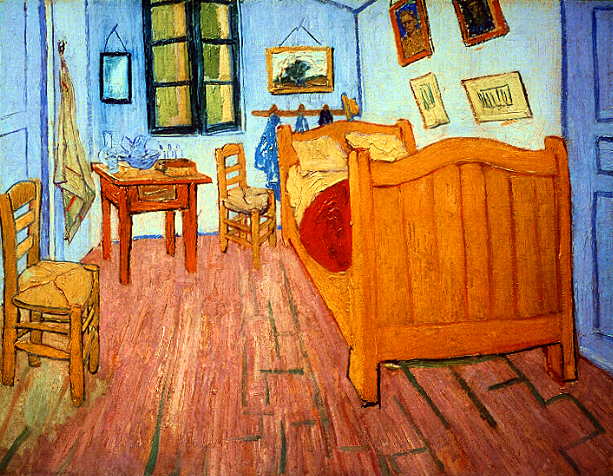
http://www.ibiblio.org/wm/paint/auth/gogh/gogh.room-arles.jpg
Add caption


Bear with me, this will be about writing soon enough.  But I start with the somewhat iconic words of the great Panamanian boxer, Roberto Duran, when he walked out in the eighth round of the second Ray Leonard fight.  I loved Duran and it broke my heart when he quit.  Leonard was too quick, too elusive that night and Duran just couldn’t catch him.  Frustration.
When do you walk away?  Boxers often don’t know, that’s for sure.  Every climber whoever died in the mountains probably ought to have walked away earlier, that’s also for sure.  And writers?  That can be a pretty tough call, too.  Elmore Leonard thought he was writing his last book, until yesterday when he was awarded a medal for Distinguished Contribution to American Letters.  He said the award “energized him” and that he would write on.  Leonard is 87.
Last week Philip Roth announced that he wouldn’t write anymore.  This can hardly be considered a loss: he’s written more books already than almost anyone has read.  It would be highly doubtful to imagine that his best work would have been ahead of him: he’s almost eighty, with thirty books to his name.  When we need him, he’ll still be there in his thirty books.  I think I have only read four of them.
So, I’m not disturbed by that announcement.  But I do find his “advice” to Julian Tepper disheartening:
http://tpr.ly/X3XGcH
Disheartening because, well, it suggests that Roth would wish away those thirty books, wish away the life he’s led.  And that’s more than disheartening, it’s heartbreaking.
And good for Tepper. I’m buying his book immediately based on his reaction.
But the heart of this message is yet another public announcement of retirement from the writing life, by the British writer and climber, Andy Kirkpatrick:


Andy is a very very good writer.  Andy has two very fine books, Psychovertical and Cold Wars, to his name, and it’s very sad to think that there may not be any more.  
His books have won awards, justifiably, including our own little world’s most prestigious, The Boardman-Tasker.   And he has been terrific promoter of them.  I saw him at the Banff Mountain Book Awards in 2006.  His performance there was absolutely the best public performance by a writer I have ever seen in my entire life.  And I see a lot of such “performances,” including a few by Nobel Prize wining writers.  Kirkpatrick was the best.
So, I hate to see him “throw the teddy out of the pram.”
But the bottom line is this: Making a full time living from writing, and writing (itself) are two very very different animals.
You can write, and you can make it important in your life, even central.  But making a living at it, and it alone? My friends, buy a lottery ticket, play the horses, go to Vegas: you’ll get better odds.
One problem Andy alludes to, but I’m not sure the degree to which it has sunk in, is that when he started out he wrote to support his climbing. But the scales tipped and at some point he began climbing to support his writing.  This can be a very dicey predicament in which to find yourself.
His early climbs were already sufferfests.  Where do you go from there?  You up the ante, you up the ante, and pretty soon there’s nowhere to go but the cemetery in Chamonix or the crevasse on Denali.  Dead men tell no tales.
Look at the graceful writing career of David Roberts, who gave us at least two of the best American books on climbing: Mountain of My Fear and Deborah; his memoir, On the Ridge Between Life and Death is a third great book.  He kept writing long after his career of climbing at the bloody edge of the possible ended.  He became a kind of historian of exploration history.  He became a writer.  It looks like a great life, but don’t forget that the books don’t write themselves.
I know Andy is severely dyslexic and that he hammered those books out at a high price.  But I don’t know anyone whose books came easy.  Who is to say that there are not many ways to pay the high price of getting a book out into the world?  Time is the least of it.
Ray Carver used to give all of his students grades of A.  He said something like, who am I to discourage someone who may have a great masterpiece within them?  He encouraged every one of his students to try to find that masterpiece; or well, at least he didn’t discourage them.
Find your “day job,” Andy, but that doesn’t have to be mutually exclusive to the writing life.  Ours will be dimmer future without another of your books in it.
“In spite of everything I shall rise again: I will take up my pencil, which I have forsaken in my great discouragement, and I will go on drawing.”—Vincent van Gogh.
Pick up those pencils, friends!


Thursday, November 1, 2012

A Mostly Frill-less Trip Report

-->
Trip Report: A Short Walk Around the Annapurnas, Post-Monsoon 2012

First: the obligatory epigraph for all Himalayan journeys:
Something hidden.  Go and find it. Go and look behind the Ranges––
Something lost behind the Ranges.  Lost and waiting for you.  Go!
                                                                        ––Kipling

John McInerney and David Stevenson had plans for the Khumbu region (Mera Peak, + ski descent) but were foiled by six days in a row of cancelled flights to Lukla due to bad weather.  Rather than languishing at the Kathmandu airport among the increasingly restless masses, we came up with Plan B: after ten hours overland via Land Rover to Syange, followed by seven days of trekking, most of it on the fabled Annapurna circuit, we found ourselves in basecamp at about 15,500 feet, preparing for an ascent of Chulu Far East (varied heights given; about 21,000 feet).  The hoped-for ski descent was nixed based on an “if-you-fall-you-die” terrain assessment.   This became a moot decision when Stevenson awakened with Acute Mountain Sickness with oedema-like symptoms.  After a rapid 3,000 foot descent we calculated that we didn’t have time for another attempt.  Or rather, we did, but then wouldn’t have time to both try again and get ourselves out of the Range and back to Kathmandu in time for our return flights.
            We continued to work our way around the Annapurnas to the west, crossing Thorung La, the highest pass in the Himalaya (about 17,760 feet) and descending to the sacred medieval city of Muktinath, birthplace of Vishnu (although we didn’t see the manger, or swaddling clothes.   Oh, wait . . . I’m confused.  Nevermind).  From there we continued around the trekker’s circuit through the deepest gorge in the world between the giant 8,000 meter peaks, Dhauligiri and Annapurna 1.  We finished walking in Tatopani (literally: hot water) where we soaked away the grime and soreness in the legendary hot springs.  From there we took a pair of tag-team taxis to Pohkara, arriving there 26 days after leaving home.
∆∆∆